Keyboard and input guide
PolyTrack Controls Guide: Keyboard, Restart, Camera, and Editor Tips
Use this guide when you want the practical PolyTrack controls before a run: how to focus the game frame, accelerate, brake, steer, restart quickly, adjust view, and recover when a mirror does not receive keyboard input.
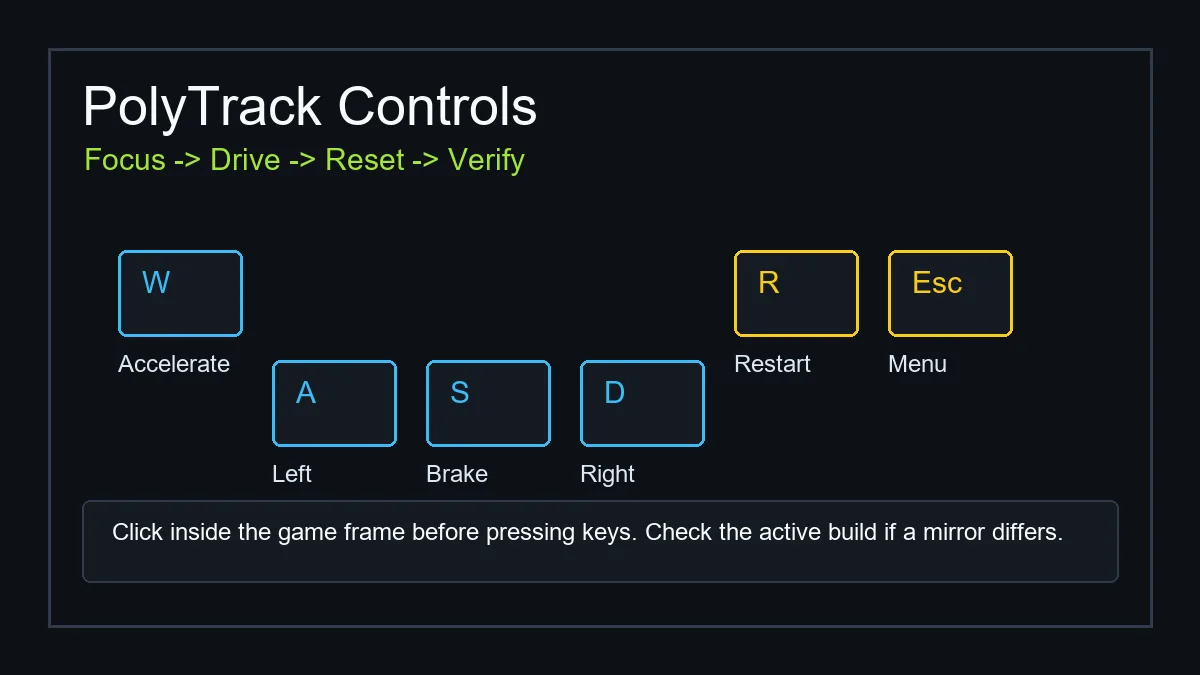
Short answer
What are the PolyTrack controls?
Most PolyTrack browser builds use familiar keyboard racing controls: accelerate, brake or reverse, steer left and right, reset after a crash, and sometimes change camera or editor view. The exact key labels can vary by version, mirror, or embedded frame, so the safest habit is to click inside the game first and then confirm the active hints in the build you are playing.
For normal driving, treat PolyTrack like a precision time-trial game. Hold acceleration on straights, feather steering through corners, brake before tight turns, and restart early when a jump or landing ruins the run. Fast resets are part of the learning loop, not a failure.
This page is separate from the main play page because the search intent is different. The homepage helps players start PolyTrack; this guide explains controls, focus problems, mobile limits, editor inputs, and why a keyboard may stop working inside an iframe.
Keyboard reference
PolyTrack keyboard controls to check first
Use the table as a practical reference, then verify the active hints inside your current build because some mirrors keep older key mappings.
| Action | Common keys | How to use it |
|---|---|---|
| Accelerate | W or Up Arrow | Hold on straights and before ramps, but release briefly if a landing needs stability. |
| Brake or reverse | S or Down Arrow | Tap before tight turns, slow for technical tracks, or recover after overshooting a checkpoint. |
| Steer left / right | A / D or Left / Right Arrow | Use small inputs instead of long holds when the car is already sliding. |
| Restart or reset | R, Enter, or an in-game reset button | Restart quickly after a crash, missed jump, or dead run so practice stays focused. |
| Camera or view | C, V, mouse, or menu option | If supported, switch view when ramps, loops, or narrow platforms are hard to read. |
| Pause or menu | Esc or on-screen menu | Use it to check version-specific control hints before assuming a key is broken. |
Practice checks
Match the control problem to the right fix
Similarweb did not return usable low-difficulty keyword rows for controls, so the GSC page opportunity is handled with practical troubleshooting, not a keyword pivot.
| Problem | Quick test | Next step |
|---|---|---|
| WASD does nothing | Click the game frame and press the arrow keys. | If arrows work, note the version's active key map before racing. |
| Car turns too sharply | Tap steering through one easy corner instead of holding the key. | Use shorter inputs and brake before the corner, not during the slide. |
| Reset key is unclear | Open the in-game menu or try R after a safe crash. | Find restart before attempting speedrun or precision tracks. |
| Mobile input feels unreliable | Connect a keyboard or test on desktop. | Treat touch play as casual; use keyboard for editor and time trials. |
| Only one mirror fails | Compare with Kodub or another trusted source. | Assume the mirror is stale or blocked rather than downloading a fix. |
Input flow
A reliable control flow before chasing a best time
Keyboard input problems often come from browser focus, iframe rules, or a stale mirror. Run this short sequence before changing browsers or looking for downloads.
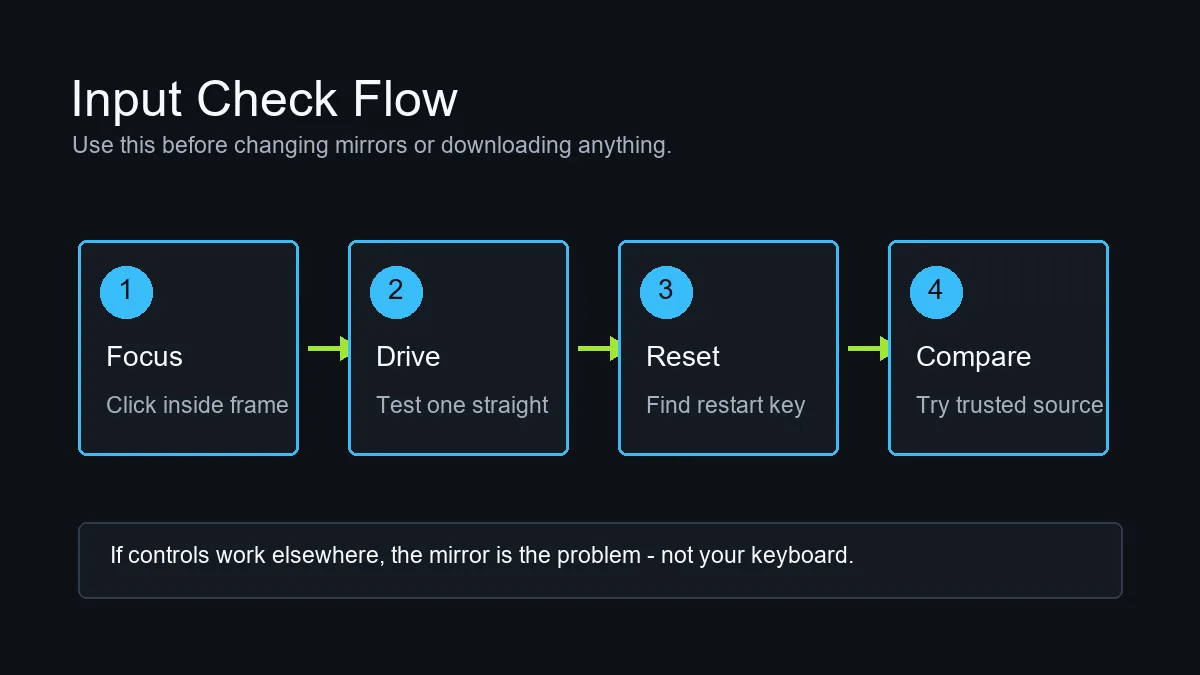
Click inside the game frame
The page, address bar, or language menu can hold focus. Click the PolyTrack canvas before pressing drive keys.
Test one clean straight
Accelerate, steer lightly, and brake once. This proves the browser is passing input to the game.
Find the reset key early
Before practicing hard tracks, identify the restart control so missed jumps do not waste the session.
Compare another source only if needed
If the same keys fail in one mirror but work on an official or known build, treat the mirror as the issue.
Editor basics
How controls change in the PolyTrack editor
Driving controls and editor controls are not the same task. In the editor, mouse placement, camera movement, undo or delete actions, and track-piece selection matter more than acceleration. If a shared tutorial mentions build mode, make sure you are not applying editor keys during a race.
When editing custom tracks, save or copy track codes often. Browser tabs can refresh, mirrors can change storage behavior, and a long layout is easy to lose if you test without a backup.
Mobile and touch
Do PolyTrack controls work on mobile?
Some browser builds open on phones, but PolyTrack is more dependable with a keyboard. Touch overlays, fullscreen behavior, and iframe focus can differ by mirror, so a mobile failure does not always mean the game is broken.
If you want serious time-trial practice, use a desktop or laptop keyboard. Mobile can be useful for checking a page or watching a run, but precise steering, quick restart, and editor work are easier with physical keys.
Practice routine
A simple control routine for faster PolyTrack runs
Spend the first minute of a new track learning the input rhythm instead of chasing a finish time. Drive one straight at full acceleration, brake before the first tight corner, then repeat the same section with smaller steering taps. This shows whether the car needs early braking, late braking, or a wider entry line.
On jump-heavy tracks, your best control is often patience before the ramp. Enter straight, avoid steering at the takeoff point, and correct only after the car settles. If you steer while airborne or land sideways, restart immediately and remember the approach angle rather than forcing a broken run.
For custom maps, test the first checkpoint, the first jump, and the restart key before committing to a full session. A track can be playable but still frustrating if the camera angle, platform width, or mirror version makes the route hard to read.
Common mistakes
Control mistakes that slow new players down
The most common mistake is holding steering too long. PolyTrack rewards short corrections because speed, jump angle, and landing direction all compound. If the car starts sliding, release the turn, let it settle, then steer again.
Another mistake is treating restart as a last resort. In PolyTrack, restart is a learning tool. When a missed checkpoint, bad landing, or wall hit costs several seconds, restarting teaches the clean approach faster than finishing a damaged run.
Troubleshooting
Why PolyTrack controls are not working
Use these checks before trusting a random download, extension, or mirror that claims it can fix input.
Frame not focused
Click inside the game canvas after the page loads. If the address bar or page body has focus, keyboard controls will not reach PolyTrack.
Keyboard layout conflict
Try arrow keys if WASD fails, close browser shortcuts, and avoid input method modes that capture letter keys.
Mobile touch mismatch
A mirror may not include usable touch controls. Test with a physical keyboard before assuming the version is broken.
Blocked or stale mirror
Network filters, iframe restrictions, or outdated hosted builds can break input. Compare with Kodub or another trusted browser source.
FAQ
PolyTrack controls FAQ
What keys does PolyTrack use?
Most builds use WASD or arrow keys for driving, plus a reset or restart key such as R, Enter, or an on-screen button. Check the in-game hints for the exact version.
Why are my PolyTrack controls not working?
The most common reason is focus. Click inside the game frame first, then test acceleration and steering. If one mirror still fails, compare with another trusted source.
Can I play PolyTrack with a controller?
Some browser environments may pass controller input, but keyboard control is the most reliable baseline. Treat controller support as version-specific.
Does PolyTrack work on mobile controls?
Some mirrors may load on mobile, but touch controls are inconsistent. For clean driving, quick restarts, and editor work, use a desktop keyboard.
Are editor controls the same as driving controls?
No. Driving focuses on acceleration, steering, braking, and restart. Editor work uses placement, camera movement, deletion, testing, and track-code backup habits.
What should I do before practicing PolyTrack speedruns?
Confirm acceleration, steering, braking, restart, and camera controls on an easy section first. A reliable reset key matters more than memorizing every optional shortcut.
Why does PolyTrack ignore keys after I change language or click a menu?
The page UI may have taken focus away from the game frame. Click back inside the PolyTrack canvas, then test one simple input before continuing.