Challenge guide
Hardest PolyTrack Tracks: Official Challenges, Community Picks & Practice Tips
There is no permanent official hardest-track ranking. Use this guide to compare the obstacles that make a PolyTrack route difficult, choose a challenge that fits your level, and practice it without turning every run into a reset marathon.

Short answer
What makes a PolyTrack track the hardest?
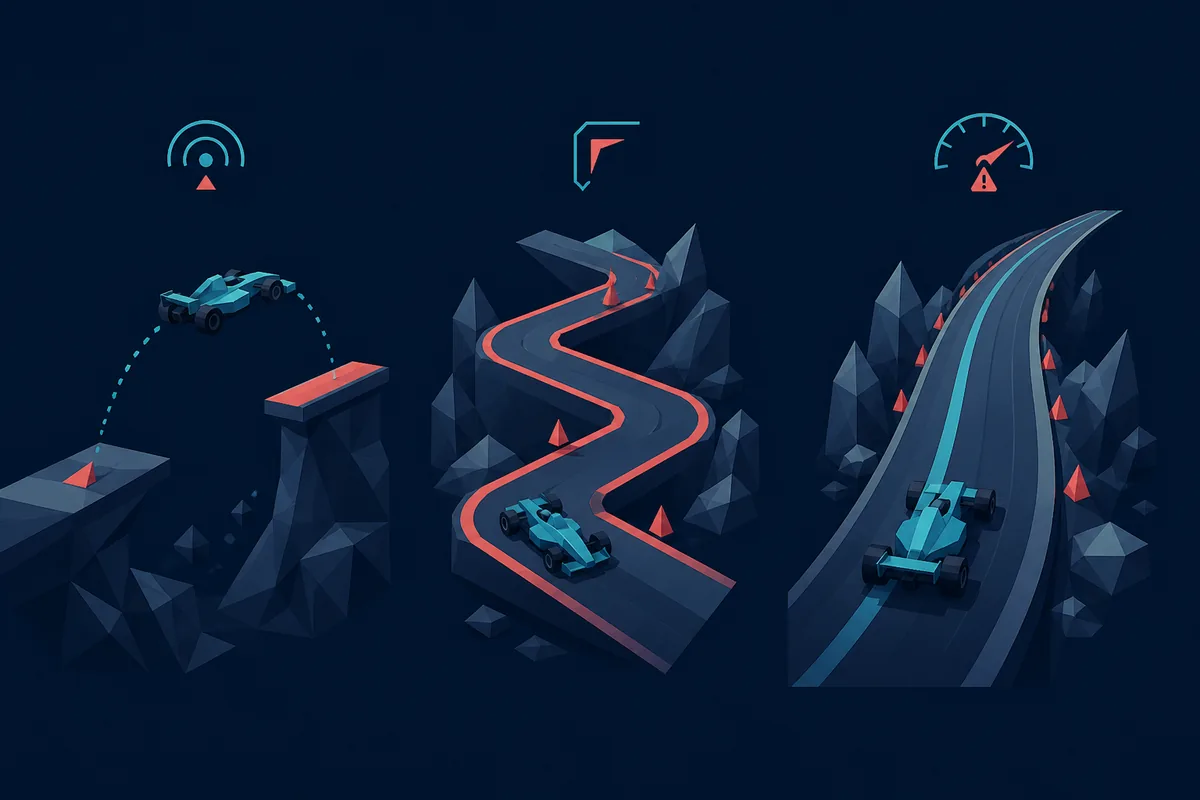
The hardest PolyTrack track is not always the longest or the fastest. A route becomes difficult when it asks for several precise decisions in a row and gives you very little room to recover after one imperfect landing. The most demanding examples usually combine a blind or elevated transition, a narrow technical line, a speed change, and a finish that arrives before the mistake has fully shown itself.
For the official campaign, treat Winter 5, Desert 4, Desert 5, and the later Summer tracks as useful challenge candidates rather than an official ranking. Their value is that they expose different weaknesses: route memory, braking, jump control, visual reference points, and consistency across a full attempt. Community tracks can be even harder, but their difficulty depends on the build, creator intent, code quality, and whether the route has been tested by other players.
The practical answer is to choose the hardest track that still gives you useful feedback. If you cannot finish a route, first use the controls, first-person, or custom-tracks guides to remove an input or import problem. Then return here and practice one obstacle at a time. A repeatable safe line is a better starting point than a spectacular run that you cannot reproduce.
Difficulty scorecard
Compare the five difficulty factors before calling a track hard
Use these factors to explain why a route feels difficult. They are a practical editorial framework, not an official PolyTrack rating or a replacement for a live leaderboard.
| Difficulty factor | What it tests | Useful practice target |
|---|---|---|
| Commitment jumps | Takeoff speed, air control, and landing direction when the next surface is hard to see. | Players who reset after one missed jump. |
| Technical links | Several turns or corrections without a straight section that lets the car settle. | Players who can drive one corner but lose the next line. |
| Low recovery space | How well you protect a run when the car touches a wall, edge, or bad landing. | Players whose safe runs collapse after a small mistake. |
| Route memory | Remember the next checkpoint, height change, and braking reference before committing. | Players who drive reactively instead of preparing the next section. |
| Record pressure | Repeat the same line over a full run instead of relying on one lucky split. | Players moving from completion times to PB or WR practice. |
Official campaign candidates
Which official PolyTrack levels are good hard-track tests?
The official campaign uses simple family-and-number names, so a search for the hardest PolyTrack levels often needs a little interpretation. The level list is the stable source for order; this page adds a difficulty lens. The candidates below are not presented as Kodub's official ranking. They are practical places to test a specific skill before you move to community maps.
Summer 6 and Summer 7 are useful when you want to test speed control without abandoning the familiar Summer visual language. Winter 5 is a strong precision and recovery test, while Desert 4 and Desert 5 ask you to connect technical inputs at speed and protect the run after a good opening. Your own hardest track may be earlier if one obstacle exposes a specific weakness.
If you are unsure which level name you saw, use the complete PolyTrack level list first. It separates the official 17-track campaign from community content and gives each family a clear practice focus. That distinction matters when a mirror, a video, or a community code uses a nickname that is not the official campaign name.
| Challenge candidate | Why it can feel difficult | First practice goal |
|---|---|---|
| Summer 6 | Faster sections punish oversteering and make a small correction cost more speed. | Repeat the approach to the first major direction change with calm inputs. |
| Summer 7 | It combines the Summer skill set, so an unstable earlier habit can follow you through the whole run. | Finish a clean baseline before chasing a faster opening. |
| Winter 5 | The final Winter test rewards precision, route memory, and a recovery plan after imperfect landings. | Memorize the next checkpoint before committing to each transition. |
| Desert 4 | Technical inputs arrive at speed, and a strong first split can create pressure to overdrive the next section. | Mark one braking reference and protect the exit line. |
| Desert 5 | The campaign finale asks you to connect several demanding sections rather than solve one isolated trick. | Practice the weakest section, then return to full runs. |
| A verified community challenge | Creator-made routes may remove recovery space or combine unusual jumps that official levels teach more gradually. | Record the source, build, code, and a safe first route before judging it. |
Community challenges
How to find hard community tracks without mistaking a code for a ranking
Community tracks are where many of the hardest PolyTrack challenges appear, but they are also the least stable part of the search landscape. A directory may list a difficult route, a creator may update its code, and a mirror may preserve an older build. “Hardest” can describe a precision jump, a meme route, a speedrun test, or simply a track that has not been playtested well enough to be fair.
Start with the source context, not the adjective. Save the creator or community page, the track name, the version, and any notes about controls or required settings. Test the start, checkpoints, respawn behavior, and finish before spending an hour on a record attempt. For code workflows, use the existing PolyTrack maps and custom-tracks guides rather than treating a search result as an official download.
The high-signal community question “how to beat the BWW PolyTrack” is a good example of why a single query should not become a new standalone page. BWW is not a stable official campaign label in the sources checked for this guide, so it belongs as a practical FAQ and source-checking problem. If the creator's page defines the abbreviation, follow that route; if not, verify the exact code and build before trying to solve it.
Choose by skill
Pick the hardest PolyTrack track that matches your current goal
Difficulty is useful only when it tells you what to practice next. Choose a route by the feedback you want, not by the most dramatic title in a search result.
You still miss basic landings
Start with a late Summer or early Winter route and practice speed, steering rhythm, and the restart loop. A hard community jump will hide the real input problem.
You can finish but lose the line
Choose Winter 5 or a technical Desert candidate. Slow down the entry, identify one braking reference, and repeat the corner until the exit is predictable.
You want a serious PB
Use the official level directory or a well-documented community source, then separate completion practice from record practice. Do not mix versions or categories.
You want a novelty challenge
Try a verified community track after saving its source and code. Label it as a community challenge, not as a permanent official hardest-track ranking.
Practice flow
A repeatable way to beat a hard PolyTrack track
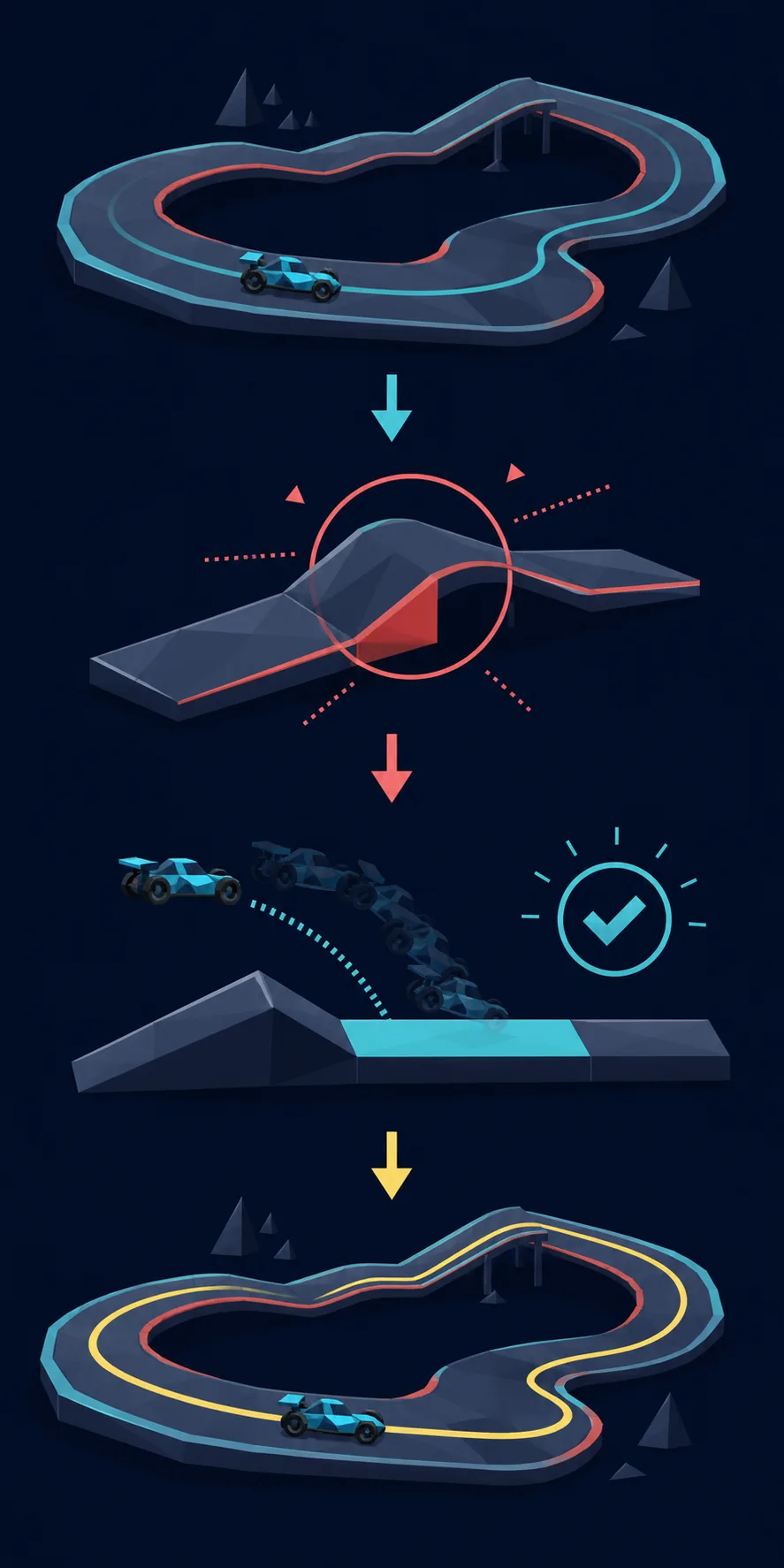
A difficult route becomes manageable when every reset answers a small question. Start with one safe full run so you know where the route breaks. Then isolate the first unstable jump, corner, or landing. Repeat the setup rather than restarting at random, and return to full runs only after the correction works more than once.
This is also the best answer to broad questions such as “how do I get an insane time on Summer 6?” and track-specific questions such as “what is a good Summer 1 time?” A record is a moving target, but a practice loop remains useful even when the leaderboard changes.
1. Baseline
Finish once before you optimize
A safe completion gives you a map of the route. Note the first section where you lose control, the first section where you lose speed, and the point where you start driving from memory instead of from the next visible reference.
Do not call a track impossible after one failed attempt. If the source is new, also check that the code is complete, the build is compatible, and the controls are responding normally.
2. Isolate
Practice the setup, not just the mistake
If a jump fails, repeat the approach speed and steering angle that create the jump. If a technical corner fails, repeat the entry and brake point. The useful unit is the few seconds before the failure, not the failure animation itself.
Use a stable camera and input setup while learning. Switch to first person only when it makes the next landing easier to read, not because the view looks more impressive.
3. Protect the exit
A slower clean exit often beats a fast reset
Hard PolyTrack routes punish the habit of maximizing entry speed while sacrificing the next section. When a route is new, choose the line that leaves the car settled and pointed at the next checkpoint. Increase speed only after the exit is repeatable.
This is especially important for Summer 1 WR questions and community challenge tracks. A leaderboard time can be faster, but your first target should be a time you can reproduce without guessing.
4. Return
Reconnect the section to the whole lap
After a correction works, run the full track again. If the mistake returns, reduce the target: practice the transition before it, shorten the session, or use a slower line. The goal is to turn a local trick into a dependable route.
For broader speedrun coaching, continue to the PolyTrack speedrun guide. For input or camera failures, use the controls and first-person guides before judging the track's actual difficulty.
FAQ
Hardest PolyTrack Tracks FAQ
What is the hardest PolyTrack track?
There is no permanent official answer. A practical shortlist starts with difficult official campaign candidates such as Summer 6, Summer 7, Winter 5, Desert 4, and Desert 5, then expands to well-documented community challenges. Your hardest track depends on whether jumps, technical corners, route memory, or record pressure is the limiting factor.
How do I beat the BWW PolyTrack?
First identify what BWW means on the creator or community page and confirm the exact track code and build. Then use the baseline-isolate-repeat-full-run flow in this guide. Because BWW is not a stable official campaign name in the checked sources, do not assume that a search snippet defines one universal route.
How do I get an insane time on PolyTrack Summer 6?
Start by recording a safe Summer 6 finish, then isolate the first fast section where oversteering costs speed. Repeat the entry and exit until they are predictable, and only then reconnect the section to full runs. Use the speedrun guide for broader PB practice and check the active category before comparing records.
Is the hardest PolyTrack track the same as the fastest track?
No. A route can be mechanically difficult but slow, or visually simple but extremely competitive because small time losses matter. Separate challenge difficulty from leaderboard difficulty and label community claims clearly.
What is a good PolyTrack Summer 1 world-record time?
World-record times are dynamic and depend on the category, version, platform, and current leaderboard. Use the public PolyTrack level and leaderboard directories for the current number instead of copying a stale time into a static guide. This page focuses on how to practice, not on a permanent record claim.
Are the hardest PolyTrack tracks official or community-made?
Both can be challenging. Official levels are easier to identify and compare because their names and order are stable. Community tracks can be more extreme, but you should record the creator, source, version, and code before treating one as a reliable challenge.
Should I use hacks or cheats for a hard PolyTrack track?
No. Similarweb shows mixed demand around hacks and cheats, but that wording can lead to unsafe mirrors or misleading downloads rather than useful skill advice. Use a controlled practice route, the official game source, and the controls or speedrun guides instead.
Where can I find hard PolyTrack map codes?
Start with the PolyTrack maps and custom-tracks guides, then use a clearly identified community directory or creator post. Check the source, build, code completeness, checkpoints, and finish before spending time on a difficult route.
Source context
Sources checked for this challenge guide
Checked August 7, 2026. Official and live sources are linked for verification; rankings, records, and community codes can change after publication.
- Kodub PolyTrack on itch.io — creator-owned source for the game and release context
- Speedrun.com PolyTrack levels — live public level and category reference; confirm current rules before comparing records
- PolyTrack Codes community directory — third-party community challenge source, not an official ranking
- itch.io PolyTrack community — community context for creator-made tracks and discussions